

Dohyō Tori: Nori-Belted Crispy Chicken in a Black Garlic Sumo Ring
A sumo-inspired plate. Black garlic sauce is drawn into a ring like the dohyō, with a disc of seasoned short-grain rice in the center as the clay floor. Two thick blocks of crispy-skin chicken, each belted with a strip of nori like a mawashi, face off on top. Pickled mustard seeds, yuzu kosho, sudachi, and a ceremonial pinch of flaky salt finish it.
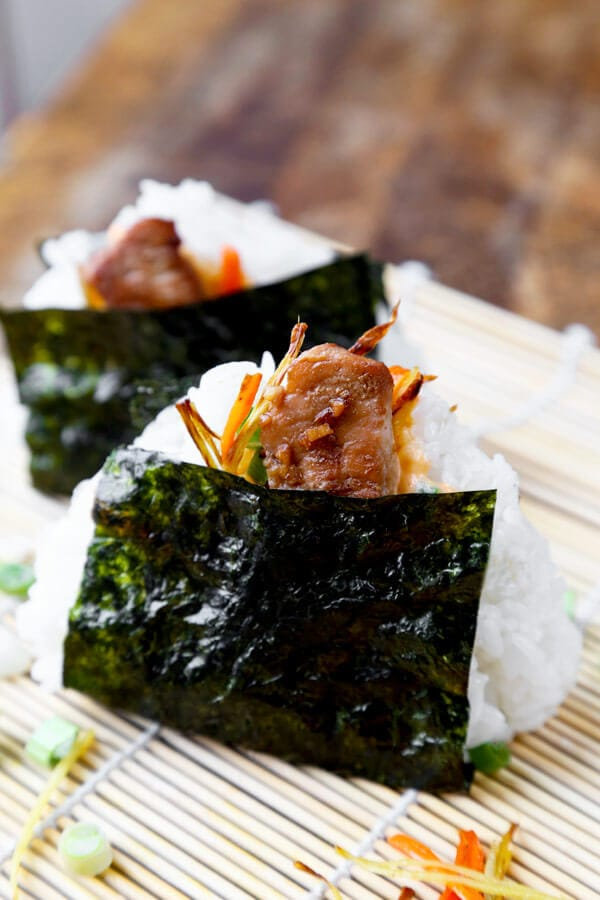
Two crispy-skinned chicken "rikishi" in nori mawashi square off on a bed of rice inside a black garlic dohyō. Inspired by the Aki Basho.
Why It Works
The concept is sumo, but the technique is what makes it eat well. Dry-brining and a cold-pan, skin-down sear render the fat slowly into a glassy crust, and cutting the chicken into tall, squat blocks keeps that crust on top and out of the sauce. Sous vide at 150°F pasteurizes the chicken while keeping it juicy and blush-colored, a safe way to get the look of Japanese jidori tataki with US chicken. The nori belt goes on at the last moment because the skin's steam and fat will soften it within minutes. Lightly seasoned rice underneath catches the juices and gives every bite a base, and the black garlic ring works as both the frame and the sauce: sweet, balsamic, deeply savory, and dark enough to read as a crisp line on a pale plate. The mustard seeds, yuzu kosho, and sudachi add the acid and heat that cut through the rich skin.
Inspired by the Aki Basho in Tokyo.
Pairings
- Shio chanko nabe as a first course, the wrestlers' own meal
- Lemon sour or a yuzu highball
- Dry junmai sake or a crisp Riesling
- Grilled kabocha with miso butter
Yield
2 plates (2 "wrestlers" each)
Time
1 hour 30 minutes (plus 2 hours to overnight dry-brine; mustard seeds best made a day ahead)
Equipment
- Heavy skillet (carbon steel or cast iron)
- Sous vide circulator (optional, recommended)
- Instant-read thermometer
- Blender or immersion blender
- Squeeze bottle or small offset spatula (for the ring)
- 4" ring mold (for the rice) and a 7–8" ring mold or plate rim as a guide for the sauce ring
- Large flat white or pale plates (for contrast)
- Wire rack over a sheet pan
Ingredients
- Chicken "rikishi"
- 2 skin-on boneless chicken breasts (about 250 g each), or thighs
- 5 g salt (about 1% of the meat's weight)
- 5 g neutral oil
- 1 sheet nori, cut into 4 strips about 3/4" wide (the mawashi)
- Rice (the dohyō floor)
- 300 g cooked Japanese short-grain rice, warm
- 10 g rice vinegar, 3 g sugar, 1 g salt (a light seasoning, not full sushi rice)
- Toasted white sesame seeds
- Black garlic sauce (the ring)
- 1 head black garlic (about 40 g peeled cloves)
- 30 g chicken stock or dashi
- 10 g shoyu
- 10 g mirin
- 5 g rice vinegar
- 5 g honey
- 10 g unsalted butter
- Pickled mustard seeds
- 40 g yellow mustard seeds
- 80 g rice vinegar, 60 g water, 25 g sugar, 2 g salt
- To finish
- Yuzu kosho
- Sudachi or lime wedges
- Flaky salt (for the ceremonial salt throw)
- Optional: a few puffed rice or arare crackers, for the straw-bale edge (tawara)
Instructions
Ahead
- Pickled mustard seeds: rinse the seeds, then simmer with the vinegar, water, sugar, and salt on low for 40–45 minutes, adding water as needed, until plump and caviar-like. Cool and jar.
- Dry-brine: salt the chicken evenly and rest it skin-side up on a rack, uncovered, in the fridge for 2 hours to overnight.
Black garlic sauce
- Blend the black garlic, stock, shoyu, mirin, vinegar, and honey until completely smooth. Warm and whisk in the butter. It should be thick enough to pipe and hold a line, like a loose paste. Load it into a squeeze bottle and keep warm.
Cook the chicken
- Sous vide: 150°F / 65.5°C for 1.5–2 hours (pasteurized, juicy, rosy). Chill in ice water 10 minutes, then pat the skin very dry. Or stovetop/oven: sear as below, then finish at 375°F to 160°F internal (it carries over to 165°F).
- Sear: lay the chicken skin-side down in a cold, lightly oiled skillet. Turn to medium and cook without moving it for 8–12 minutes until the skin is deep golden and glassy. Flip and kiss the flesh side for 30 seconds. Rest 5 minutes.
- Cut the wrestlers: trim each breast into 2 thick, squat blocks about 2" × 3". Stand them skin-side up. Chunky and upright reads as "sumo."
Rice
- Dissolve the sugar and salt in the vinegar, and fold it gently into the warm rice.
Plate the dohyō
- Center a 4" ring mold on the plate and press in the rice about 1/2" thick. Lift the mold to leave a clean disc. Dust it lightly with sesame.
- Using a larger ring or the plate's well as a guide, pipe the black garlic sauce in a bold ring around the rice with a small gap between them, like the dohyō's straw-bale boundary. Smooth it with the back of a spoon or an offset spatula. If you like, add two short parallel lines inside the ring on the rice as the shikiri-sen (starting lines).
- Belt the wrestlers at the last second: wrap a nori strip around the middle of each chicken block, sealing the overlap with a dab of black garlic sauce or a grain of rice. Wrap just before serving so the nori stays crisp and the skin stays glassy.
- Stand the two wrestlers on the rice facing each other, as if at the tachi-ai.
- Place a small mound of pickled mustard seeds and a dot of yuzu kosho just outside the ring (the "corners"), and set a sudachi wedge beside them. Tuck a few arare along the ring's edge as the tawara, if using.
- At the table, throw a pinch of flaky salt over the ring, like the wrestlers' purifying salt throw (shio-maki). Then eat.
Tasting Journal
Plating sketch: the original dohyō concept, drawn on a guest check at the izakaya in Japan: two nori-belted wrestlers on rice inside a black garlic ring.
